
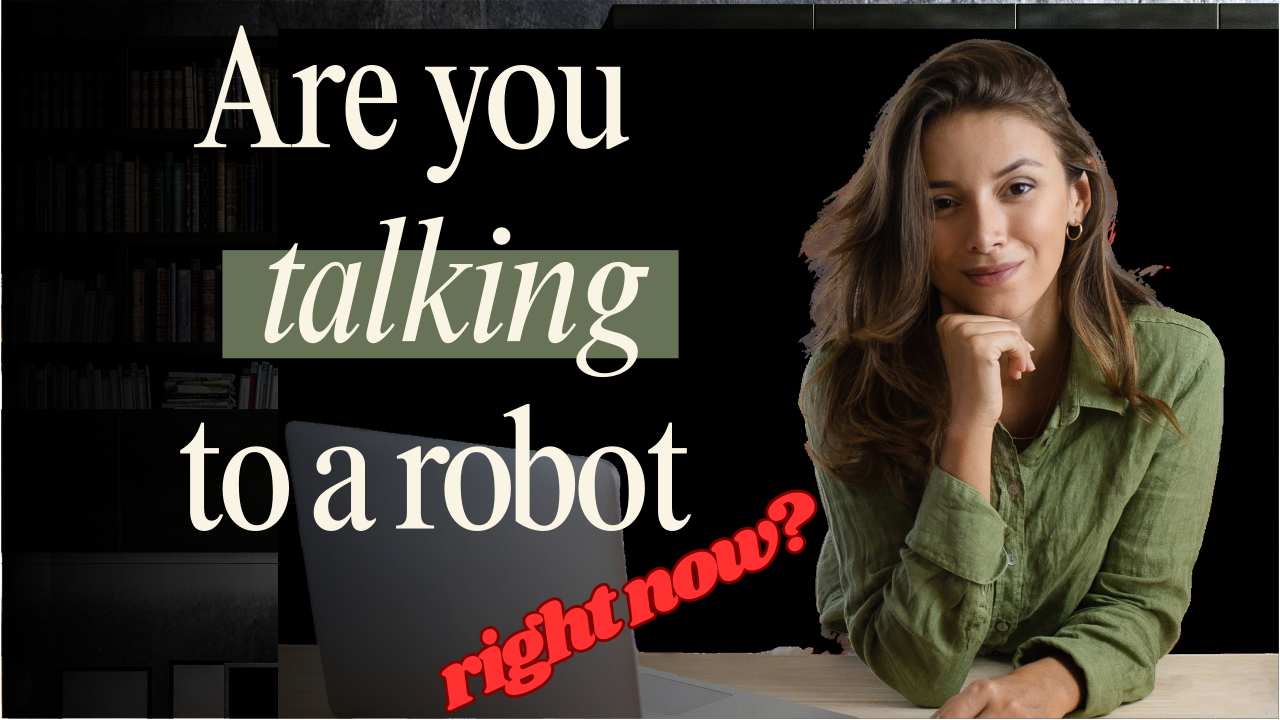



In the age of digital whispers and silicon conversations, the lines between human and machine dialogue are blurring faster than ever. Whether you’re seeking customer support, scrolling through social media, or simply engaging in a friendly chat, there’s a good chance that the voice-or text-on the other end might not be human at all. But how can you tell when you’re talking to a robot without even realizing it? This article dives into the curious world of artificial interlocutors, exploring how they’ve woven themselves seamlessly into our daily interactions and what it means for the future of communication.
The Subtle Algorithms Behind Conversational AI That Blur the Lines of Human Interaction
- Contextual Adaptation: Algorithms dynamically adjust tone, formality, and complexity to mirror your style.
- Conversational Memory: Retaining previous interactions creates continuity that feels remarkably natural.
- Subtext Recognition: Detecting implied meanings and sentiment shifts beyond direct statements.
- Response Variability: Avoiding robotic patterns through diverse phrasing and creative language generation.
These features allow machines to engage more like storytellers than calculators. Below is a simple breakdown of how different AI models play their roles in crafting this illusion:

| AI Model | Core Function | Impact on Interaction |
|---|---|---|
| Generative Pre-trained Transformer (GPT) | Language Prediction | Crafts coherent, context-aware sentences |
| Recurrent Neural Network (RNN) | Sequence Processing | Maintains conversation flow and memory |
| Sentiment Analysis Modules | Emotion Detection | Adjusts tone based on user sentiment |
Strategies for Identifying and Adapting to AI Voices in Everyday Communication Scenarios
In the age of seamless AI integration, recognizing the subtle cues of artificial speech can transform mundane interactions into moments of curiosity and clarity. One effective approach is to focus on the rhythm and emotional fluctuations of the voice. AI-generated speech often lacks the natural unpredictability of human emotion-notice if the tone feels too consistent or strangely neutral, even when discussing charged topics. For instance, in customer service calls, an AI might repeat phrases with unnerving precision, whereas humans frequently insert small hesitations or personalized remarks. Also, listen for odd pronunciation or unnatural pacing, such as slight delays on simple words or unnatural emphasis, which can signal robotic origins.
Adapting to AI voices requires a mindset shift from frustration to engagement. Embrace strategies like asking open-ended questions that AI might struggle to answer creatively, thus revealing its boundaries. When interacting with virtual assistants, try varying your language or rephrasing inquiries to test the flexibility of the response system. Maintaining a small mental checklist can help you navigate conversations more smoothly:
- Detect monotony: Does the voice lack natural breaks or spontaneous reactions?
- Check context awareness: Does it understand nuanced or indirect references?
- Test adaptability: Does it respond accurately when phrasing changes?
| AI Voice Trait | Human Voice Contrast |
|---|---|
| Uniform pitch | Varied intonation |
| Precise yet awkward phrasing | Fluid, conversational flow |
| Instant, mechanical responses | Brief pauses and thinking time |
By sharpening your ear and adjusting expectations, you not only decode robotic conversations but also refine your communication skills, making everyday interactions richer whether human or machine is on the other end.
In Retrospect
As the lines between human and machine blur in our everyday conversations, it’s worth pausing to consider who-or what-is truly on the other end of the chat. Whether it’s a helpful assistant answering your questions or a customer service bot guiding your purchase, robots have quietly woven themselves into the fabric of our communication. The next time you find yourself typing away, wondering if your words are reaching a person or a programmed mind, remember: in this digital age, the question isn’t just “Are you talking to a robot?” but “Does it even matter?” After all, the future of conversation might be less about who’s responding and more about how meaningfully we connect-no matter the voice behind the screen.